MODULE EXPLORER
THE QUESTION IT HELPS ANSWER
CONCEPTUAL PRODUCT WORKFLOW
Connect your production, machines, quality, materials and people in one intelligent manufacturing platform.
See what’s happening. Know what needs attention.
Keep your factory moving.
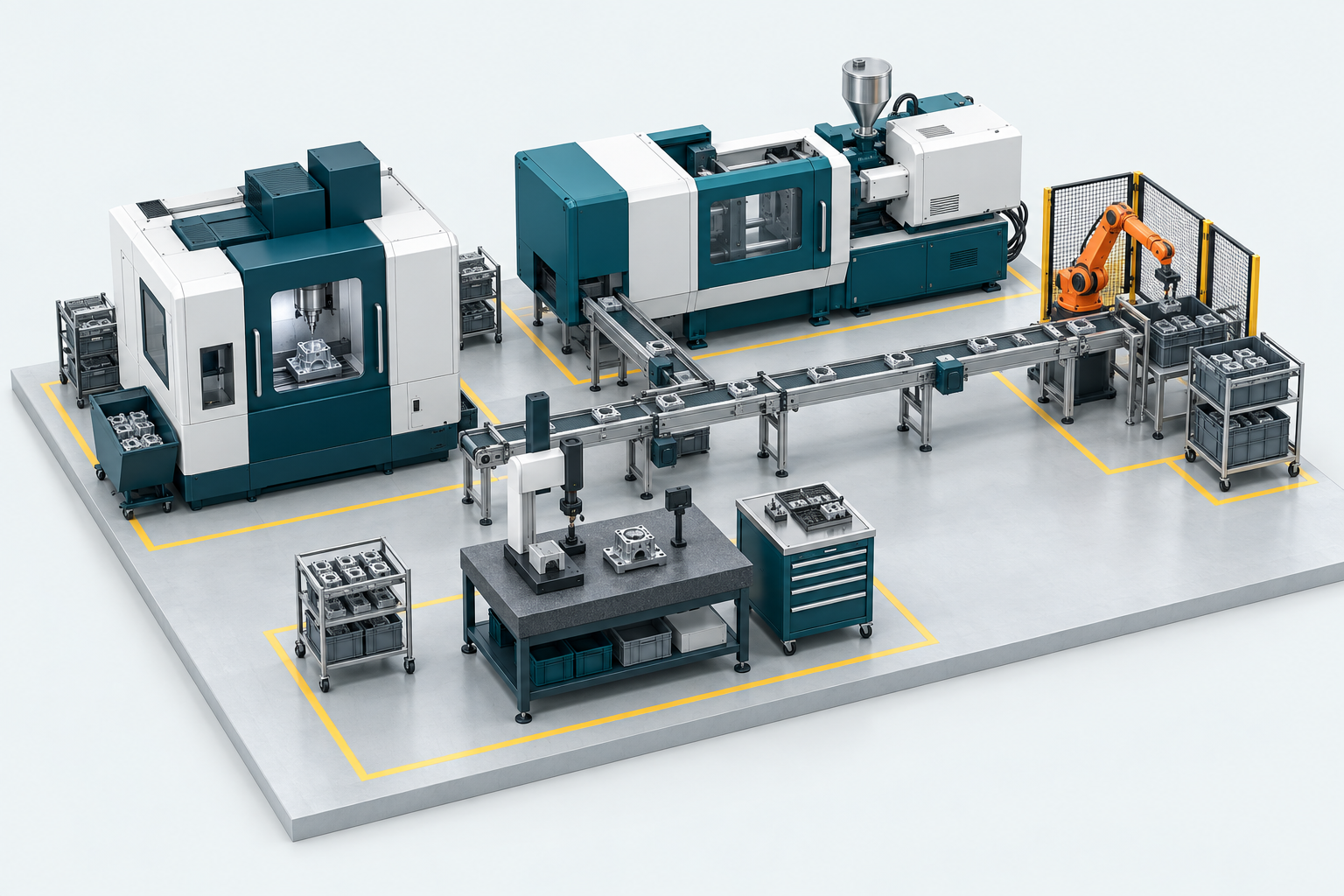
When plans live in Excel, updates live in WhatsApp, and machine data lives nowhere, the whole picture arrives too late. Poldu is designed to bring those pieces into one operating view.

Explore the work behind every production number.
Select an area to see how it connects.
Follow the job from customer demand to dispatch.
One work order. A traceable execution story.
Good and rejected quantities remain traceable to the plan, machine, shift, employee, and production entry.
Running, idle, warning, or breakdown.
Go from a machine’s status to its operating context.
Connect inspections to production.
Connect tooling care to actual usage.
Configure checks for your product and process. Record the result, route rejected pieces, and keep rework visible.
Example parameters for a molded part. Click the surface result to explore pass / rework.
shots remaining
Illustrative 70% review threshold. Life and maintenance tracking—not a prediction of tool failure.
A machine cycle is more than a signal. With the right connection and context,
it becomes a production record, a status update, or a reason to act.
For a mold with multiple active cavities, one machine cycle may produce several pieces. Tooling usage still records the shot.
Conceptual arithmetic, not a verified Poldu calculation. Actual good quantity depends on active cavities, rejects, validation rules, and the configured implementation.
Enter a whole number of cycles between 1 and 1,000,000.
Threshold crossed → alert raised.
Route the temperature exception to the responsible operator for investigation.
Sensor limits are examples, not engineering safety limits. Thresholds must be validated for the specific equipment and process.
Device identity → company → machine → telemetry. The design uses authenticated device access and machine mapping. Protocols, API-key handling, buffering, and processing behavior require implementation and site validation. No real credentials are shown.
These configurations explain how manufacturing requirements differ. They are not verified prebuilt templates, database features, or regulatory compliance claims.
Explore a working interface preview.
Change the shift, inspect the numbers, find the priority.
Here’s how the floor is performing this shift.
2 operating priorities: investigate the temperature exception on IM-08 and check the breakdown on CUTTING-02.
| Work order | Product | Progress | Status |
|---|---|---|---|
| WO-0048 | Modular kitchen | 52 / 80 | In production |
| WO-0049 | Cabinet panel | 460 / 500 | In quality check |
| WO-0050 | Drawer assembly | 50 / 200 | Material review |
QC batch cleared Cabinet panel · 2 min ago
Service threshold reachedDie A-104 · 8 min ago
24 IoT devices onlineGateway health · 10 min ago
Swipe to explore the full dashboard. Change the shift or chart to interact.
Map how your factory actually runs.
Then connect the next part of the picture.
Poldu’s product vision is a shared operating layer for production, machines, quality, people, tooling, and industrial data.
The screens on this website are interactive product concepts. Manufacturing integrations and workflows must be confirmed against your deployment. Use the enquiry form to send a demo request to the team.
An MES connects production plans with what actually happens on the factory floor. It brings work orders, machine activity, production quantities, people, quality checks, and losses into one operational record so teams can understand progress and follow up on exceptions.
The product concept is intended for manufacturing businesses and the people who run them: factory owners, plant managers, production teams, quality leads, maintenance teams, and supervisors. A walkthrough should confirm fit against your actual process.
The proposed operating model can be adapted around different products, production units, processes, and QC parameters. The eight sector examples on this website are illustrative configurations, not verified prebuilt industry templates or compliance claims.
The conceptual flow is machine → PLC or sensor → device or gateway → authenticated API → company and machine mapping → telemetry processing. Protocol compatibility, sensor quality, buffering, and processing rules must be confirmed for each implementation.
No. The product architecture described in the brief includes production entries alongside IoT concepts. Manual entry and machine integration can be considered during discovery; which workflows are available must be confirmed against the deployed product.
The intended workflow links an inspection to a production entry, checks the configured product parameters, and records pass, rejection, or rework. The specific checks and release rules depend on the manufacturing process.
The concept includes downtime incidents, service history, tool and die usage, shot counts, and maintenance thresholds. A life-used indicator tracks recorded usage; it does not predict when a tool will fail.
The supplied product brief describes a tenant-based structure with users, departments, roles, permissions, and audit logs. Tenant isolation and MES authorization cannot be verified from this marketing codebase and must be reviewed in the actual product.
No. Every machine status, counter, chart, work order, and sensor reading on this public website is an illustrative product preview. No factory equipment is connected to this website.
No. The product vision includes contextual insights and a path toward predictive use cases, but this website does not run an AI service or predict equipment failures. Such capabilities require actual implementation, suitable historical data, and site validation.
Tell us how your manufacturing operation works.
Let’s explore where better visibility could make the difference.
ONE FACTORY.